Do You Need to Use the Inching Pedal on a Forklift
The inching pedal on a forklift is a small but powerful tool that helps operators control speed and precision during tight maneuvers. Whether you are loading docks, navigating narrow aisles, or handling delicate loads, understanding when and how to use the inching pedal can make a huge difference in forklift safety and material handling efficiency. This guide breaks down everything you need to know about inching pedal use, from basic function to advanced tips.
If you have ever walked past a warehouse and watched a forklift glide smoothly into a loading dock, you might have wondered about the controls making that look so easy. One of those controls is the inching pedal. It is a small foot pedal that many operators use every day, yet plenty of people are unsure about when and why to use it.
So, do you really need to use the inching pedal on a forklift? The short answer is yes, but with some important nuances. The inching pedal plays a vital role in forklift operation, especially during precision tasks. However, using it incorrectly can lead to equipment damage or safety hazards. In this article, we will walk you through everything you need to know about the inching pedal, how it works, when to use it, and common mistakes to avoid.
Whether you are a new operator getting certified or a seasoned warehouse worker looking to sharpen your skills, this guide will give you practical, actionable insights. We will cover the mechanics, real-world applications, and expert advice that will help you operate your material handling equipment with confidence and safety.
Key Takeaways
- Inching pedals give operators fine control over forklift speed: They are essential for precision tasks like stacking and docking.
- Not every situation requires the inching pedal: Straightforward travel at higher speeds often does not need it.
- Improper use can cause wear and safety issues: Over-relying on the inching pedal can overheat the clutch and hydraulic system.
- Training matters: Certified operators learn proper forklift operation techniques, including pedal coordination.
- Electric and internal combustion forklifts differ: The inching pedal works differently depending on your industrial vehicle type.
- Quick tips can prevent costly mistakes: Simple habits like smooth pedal pressure extend equipment life.
- Safety always comes first: Using the inching pedal correctly reduces workplace accidents and load damage.
📑 Table of Contents
What Is the Inching Pedal on a Forklift?
The inching pedal is a foot-operated control found on most forklifts. It allows the operator to slow down or stop the forklift without fully disengaging the drive system. Think of it as a bridge between full speed and a complete stop. It gives you slow speed control when you need it most.
On many forklifts, the inching pedal also disconnects the hydraulic control linkage temporarily. This means you can move the forklift forward or backward while still having independent control over the lifting mechanism. That dual function makes it a unique and important part of forklift driving.
How Does It Differ from the Brake Pedal?
It is easy to confuse the inching pedal with the brake pedal. The brake pedal brings the forklift to a full stop and slows it down quickly. The inching pedal, on the other hand, is designed for gradual, controlled speed reduction. You use the brake when you need to stop completely. You use the inching pedal when you need to creep forward or backward at a very low speed.
Here is a simple way to remember it. The brake stops you. The inching pedal lets you creep. Both are essential, but they serve different purposes in forklift operation.
What Does the Inching Pedal Look Like?
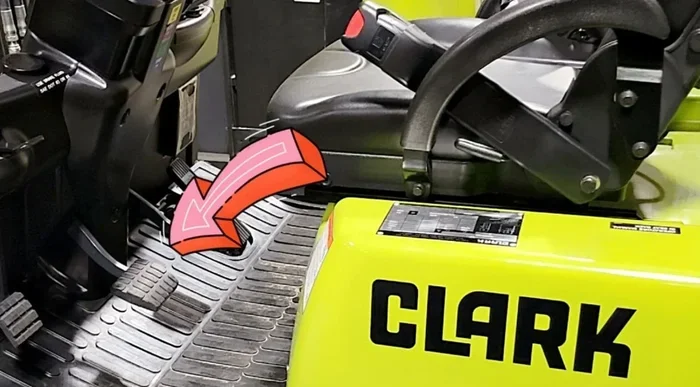
Most inching pedals are located on the floor to the left of the operator. They are usually smaller than the brake pedal and sit slightly higher. Some forklifts have a dedicated inching pedal, while others combine it with a clutch pedal. The design varies depending on the industrial vehicle manufacturer and model.
Electric forklifts often have a different pedal setup than internal combustion models. On electric forklifts, the inching function may be built into the accelerator or controlled through a separate switch. Understanding your specific forklift model is key to using the pedal correctly.
How the Inching Pedal Works
Understanding how the inching pedal works mechanically helps you appreciate why it matters. When you press the inching pedal, it partially disengages the clutch assembly. This allows the forklift to move at a very slow speed while keeping the engine or motor running at a higher RPM.
At the same time, pressing the inching pedal can also isolate the hydraulic pump from the drivetrain. This means you can raise, lower, or tilt the forks while the forklift itself moves at a crawl. That level of precision maneuvering is critical in tight spaces.
The Clutch Connection
On manual transmission forklifts, the inching pedal acts like a secondary clutch. It lets you shift gears smoothly while keeping the forklift in motion. Without the inching pedal, you would have to stop completely to change gears, which wastes time and reduces productivity in busy warehouse equipment environments.
However, overusing the inching pedal as a clutch substitute can cause excessive wear. The friction surfaces on the clutch can heat up and degrade faster than normal. This is why proper technique matters so much.
The Hydraulic System Link
Many operators do not realize that the inching pedal also affects the hydraulic system. When the pedal is pressed, it can temporarily reduce hydraulic flow to the lifting cylinders. This is by design. It prevents the forklift from jerking or lurching while the load is being raised or lowered.
If your forklift maintenance schedule is not up to date, the inching pedal may not function as smoothly. Sticky pedals or worn hydraulic lines can reduce the effectiveness of slow speed control. Regular inspections are important for keeping everything in good working order.
When You Should Use the Inching Pedal on a Forklift
Now that you understand what the inching pedal does, let us talk about when to actually use it. There are specific situations where the inching pedal becomes indispensable for safe and efficient forklift operation.
During Precision Load Placement
When you need to place a load on a high shelf or align it with a narrow opening, the inching pedal is your best friend. It allows you to move the forklift forward or backward in tiny increments. Without it, you would have to use the brake repeatedly, which is slower and less precise.
Think about stacking pallets on a rack that is ten feet high. You need the forklift to move forward just a few inches at a time. The inching pedal gives you that level of control without risking overshooting the target position.
When Navigating Narrow Aisles
Warehouse aisles can be extremely tight, especially in high-density storage facilities. The inching pedal helps you navigate these narrow spaces with confidence. You can creep along at walking speed while keeping both hands on the controls for better steering and load management.
Using the inching pedal in tight aisles also reduces the risk of bumping into racking or other material handling equipment. That alone can save you from costly damage and potential workplace injuries.
During Dock Operations
Loading dock operations are another area where the inching pedal shines. When aligning a forklift with a trailer bed, you need very fine control over speed and position. The inching pedal lets you creep up to the dock plate at a safe, steady pace.
Rushing this process or relying solely on the brake can lead to misalignment, load shifts, or even trailer falls. The inching pedal helps you maintain smooth, controlled movement during these high-stakes maneuvers.
When Starting on an Incline
Starting a forklift on a ramp or incline can be tricky. The inching pedal helps you ease into motion without causing the load to shift or the forklift to jerk. It gives you a smooth transition from a stopped position to forward or backward movement.
This is especially important when you are carrying a heavy load uphill. The incremental speed control provided by the inching pedal keeps the load stable and the operator in command of the industrial vehicle at all times.
Common Mistakes Operators Make with the Inching Pedal
Even experienced operators can develop bad habits when it comes to using the inching pedal. Recognizing these mistakes is the first step toward safer and more efficient forklift operation.
Riding the Inching Pedal
One of the most common mistakes is keeping your foot on the inching pedal while driving at normal speeds. This is sometimes called “riding the pedal.” It causes unnecessary wear on the clutch and can overheat the hydraulic control system. The inching pedal is meant for short, controlled bursts of low-speed movement, not for continuous driving.
If you find yourself resting your foot on the inching pedal out of habit, make a conscious effort to keep it off until you actually need it. This simple change can extend the life of your forklift maintenance components significantly.
Using the Inching Pedal as a Brake
The inching pedal is not a substitute for the brake pedal. While it does slow the forklift down, it does not bring it to a complete stop as reliably as the brake. Using the inching pedal in place of the brake can lead to longer stopping distances and reduced safety.
Always use the brake pedal when you need to stop fully. Reserve the inching pedal for situations where you need controlled, low-speed movement without coming to a complete stop.
Ignoring Pedal Feedback
Your forklift will tell you when something is wrong with the inching pedal. If the pedal feels spongy, sticks, or does not return to its normal position, do not ignore it. These are signs of forklift maintenance issues that could affect your slow speed control and overall safety.
Report any pedal problems to your supervisor immediately. Continuing to operate a forklift with a malfunctioning inching pedal is a serious workplace safety risk.
Over-Reliance on the Inching Pedal for Steering
Some operators use the inching pedal to make tiny steering adjustments. While it is true that slowing down helps with steering precision, the inching pedal should not be your primary steering tool. Use the steering wheel for directional control and the inching pedal for speed management.
Combining both controls properly is part of good forklift training. Your certification program should cover this, but a quick refresher never hurts.
Expert Tips for Using the Inching Pedal Safely
Getting the most out of your inching pedal comes down to technique and awareness. Here are some expert tips that experienced forklift operators swear by.
Practice Smooth, Gradual Pressure
When using the inching pedal, apply pressure gradually rather than pressing down hard. Smooth pressure gives you better slow speed control and reduces wear on the clutch and hydraulic system. Think of it like pressing a gas pedal in a car, not stomping on it.
With practice, you will develop a feel for how much pressure is needed for different tasks. This instinct comes from repetition and attention to how the forklift responds.
Coordinate Pedals with Your Hands
Good forklift operation involves coordinating your feet and hands. When you press the inching pedal, your hands should be firmly on the steering wheel and the lift controls. This three-point coordination ensures you are always in control of the forklift and the load.
Try this exercise in a safe, open area. Practice pressing the inching pedal while smoothly operating the lift lever. Over time, this coordination will become second nature.
Keep Your Foot Ready, Not Resting
Keep your foot hovering near the inching pedal when you are in a situation that might require quick speed adjustments. This is sometimes called the “ready position.” It allows you to react fast without fumbling to find the pedal.
However, do not rest your actual foot weight on the pedal. Keep it hovering lightly. This way, you are always ready to use the inching pedal without accidentally activating it.
Know Your Forklift Type
Different forklifts have different inching pedal setups. Electric forklifts, internal combustion forklifts, and reach trucks all behave slightly differently. Take the time to read your operator manual and understand how the inching pedal functions on your specific industrial vehicle.
If you switch between different types of forklifts during your shift, pay extra attention to how each one responds. What works on one model may not work the same way on another.
Inspect the Pedal Before Every Shift
Make it a habit to check the inching pedal before starting your shift. Press it a few times to make sure it moves freely and returns to its resting position. Listen for any unusual sounds that might indicate mechanical problems.
This quick check takes only a few seconds but can prevent accidents and equipment downtime. It is one of the simplest and most effective forklift maintenance practices you can adopt.
Do You Always Need the Inching Pedal?
The honest answer is that it depends on your forklift type and the tasks you perform. Let us look at some comparisons to clarify when the inching pedal is essential and when it might be less critical.
| Forklift Type | Inching Pedal Present? | When It Is Essential | When It May Be Optional |
|---|---|---|---|
| Internal Combustion Counterbalance | Yes | Dock operations, narrow aisles, heavy load stacking | Open yard travel at higher speeds |
| Electric Counterbalance | Yes (often integrated) | Indoor warehouse work, precision stacking | Short moves in open loading areas |
| Reach Truck | Yes | High-rack retrieval, narrow aisle operation | Minimal travel, mostly stationary picking |
| Pallet Jack (Manual) | No | N/A | N/A |
| Order Picker | Yes | Elevated platform movement, picking at height | Short horizontal repositioning |
As you can see from the table, most powered forklifts rely on the inching pedal for key operations. Manual pallet jacks do not have one, which is why they require more physical effort for precision tasks. The inching pedal is most critical when you need precision maneuvering and slow speed control in confined or high-risk areas.
For operators who work primarily in open spaces with few obstacles, the inching pedal may see less frequent use. But even then, having it available provides a safety net for unexpected situations. You never know when you will need that extra bit of slow speed control to avoid an obstacle or adjust a load position.
The Role of Operator Certification
Proper forklift training covers the use of the inching pedal in detail. Certified operators learn not only how to use the pedal but also when it is appropriate to use it. This training is not just a formality. It directly impacts workplace safety and operational efficiency.
If you are new to forklift operation, make sure your operator certification program includes hands-on practice with the inching pedal. Understanding this control early on will set you up for safe and effective forklift driving throughout your career.
Quick Tips for Better Inching Pedal Use
- Keep your seat adjusted properly: You need full range of motion for the pedals to work comfortably.
- Wear flat-soled shoes: Slippery shoes reduce your feel for the inching pedal and can cause accidental presses.
- Use the parking brake when stopped: This takes the load off the inching pedal and reduces wear.
- Practice in a safe area: Build your pedal feel before working in high-pressure environments like busy docks.
- Stay alert to load weight: Heavier loads require more careful speed control, making the inching pedal even more important.
Common Mistakes to Avoid
- Never use the inching pedal as a brake: Always reach for the brake pedal when you need to stop completely.
- Do not rest your foot on the inching pedal while driving: This causes unnecessary clutch wear and can lead to accidental speed changes.
- Avoid pressing the inching pedal and accelerator at the same time: This creates conflicting signals to the drivetrain and can damage components.
- Do not ignore unusual pedal behavior: Sponginess, sticking, or delayed response are warning signs that need immediate attention.
Expert Insights on Inching Pedal Best Practices
Experienced forklift operators and safety professionals consistently emphasize the importance of the inching pedal in daily operations. According to industry guidelines from OSHA and the Industrial Truck Association, proper use of all forklift controls, including the inching pedal, is a fundamental part of workplace safety compliance.
Many accidents involving forklifts occur during low-speed maneuvers where precision is critical. The inching pedal gives operators the control they need to navigate these moments safely. Skipping or misusing this control removes a layer of protection that can prevent injuries and property damage.
Training programs that emphasize pedal coordination and situational awareness produce operators who are not only more skilled but also more confident. Confidence behind the controls of heavy equipment leads to smoother operations, fewer errors, and a safer work environment for everyone.
How the Inching Pedal Impacts Forklift Maintenance
The way you use the inching pedal has a direct impact on your forklift’s maintenance needs. Proper use reduces wear on the clutch, brakes, and hydraulic system. Improper use accelerates wear and can lead to costly repairs and downtime.
Operators who “ride” the inching pedal or use it as a brake generate excess heat in the clutch assembly. Over time, this heat degrades clutch materials and shortens component life. On the hydraulic side, constant partial engagement can cause uneven pressure distribution, leading to jerky lift movements and premature wear on hydraulic seals.
By using the inching pedal correctly and only when needed, you contribute to lower maintenance costs and longer equipment life. This is a win-win for both operators and facility managers who are responsible for warehouse equipment upkeep.
Key Takeaways
- The inching pedal provides essential slow speed control for precision forklift tasks.
- Use it during load placement, narrow aisle navigation, dock operations, and incline starts.
- Avoid common mistakes like riding the pedal, using it as a brake, and ignoring pedal feedback.
- Proper use extends equipment life and reduces forklift maintenance costs.
- Operator certification and regular training ensure safe and effective inching pedal use.
- Different forklift types have different inching pedal setups. Know your specific industrial vehicle.
- Workplace safety depends on using all controls correctly, including the inching pedal.
Frequently Asked Questions
What is the purpose of the inching pedal on a forklift?
The inching pedal allows operators to control forklift speed at very low levels for precision tasks. It also temporarily disconnects the hydraulic linkage, giving you independent control over both movement and lifting. This makes it essential for tasks like stacking, docking, and navigating narrow aisles.
Can you drive a forklift without using the inching pedal?
Yes, you can drive a forklift without using the inching pedal for straight travel at normal speeds. However, you will need it for precision maneuvers and low-speed tasks. Avoiding it entirely in situations that require slow speed control can reduce accuracy and increase safety risks.
Is the inching pedal the same as the brake pedal?
No, they are different. The brake pedal brings the forklift to a complete stop. The inching pedal reduces speed gradually for controlled, low-speed movement. Using the inching pedal as a brake can cause wear and reduce stopping effectiveness.
Does every forklift have an inching pedal?
Most powered forklifts have an inching pedal, but the design varies. Electric forklifts often integrate the inching function into the accelerator or a separate switch. Manual pallet jacks do not have one. Always check your specific forklift model to understand its pedal configuration.
Can improper use of the inching pedal damage the forklift?
Yes, improper use can cause significant damage. Riding the pedal continuously overheats the clutch, and using it as a brake accelerates wear on both the clutch and braking system. Over time, this leads to higher forklift maintenance costs and potential equipment failure.
How can I improve my inching pedal technique?
Practice smooth, gradual pressure in a safe, open area. Keep your foot in the ready position when you anticipate needing low-speed control. Coordinate the inching pedal with your hands on the steering and lift controls. Regular forklift training refreshers can also help you refine your technique.
=== CONCLUSION ===
The inching pedal is one of the most important controls on any forklift. It gives you the slow speed control and precision maneuvering capability that makes safe, efficient material handling possible. From loading docks to narrow warehouse aisles, this small pedal plays a big role in everyday forklift operation.
You do not need to use it for every single movement, but you absolutely need to know when and how to use it properly. Avoid common mistakes like riding the pedal or using it as a substitute for the brake. Keep your forklift maintenance schedule current so that the inching pedal always responds smoothly and reliably.
Whether you are just starting your forklift training or you have years of experience under your belt, revisiting the fundamentals of inching pedal use is always worthwhile. It keeps you safer, protects your equipment, and makes your workday more productive. Take the time to practice, stay aware, and always prioritize workplace safety above all else. The inching pedal is a tool that rewards skillful, attentive use, and mastering it is a mark of a truly competent forklift operator.