A Car of Mass M Starts from Rest and What Happens Next
A car of mass m starts from rest and begins to move because of the force created by its engine. This moment marks the start of acceleration, where Newton’s second law takes over and shapes every part of the drive. Understanding this simple physics concept helps car owners and enthusiasts grasp how their vehicles actually work on the road. From torque and friction to kinetic energy and momentum, each factor plays a big role in how the car gains speed.
Key Takeaways
- Force and Acceleration Go Hand in Hand: When a car of mass m starts from rest, the engine force directly determines how fast the car speeds up.
- Friction Is Your Friend and Foe: Traction helps the car move forward, but rolling resistance and drag slow it down over time.
- Mass Matters a Lot: A heavier car needs more force to achieve the same acceleration as a lighter one.
- Horsepower and Torque Drive Performance: These engine specs decide how quickly a car goes from zero to speed.
- Kinetic Energy Builds with Speed: The faster the car goes, the more energy it carries, which affects stopping distance and safety.
- Real-World Factors Change Everything: Road conditions, weight distribution, and tire grip all influence how a car behaves at startup.
📑 Table of Contents
- A Car of Mass M Starts from Rest: The Physics of Everyday Driving
- The Role of Force and Newton’s Second Law
- Acceleration: How Fast Does Speed Build?
- Friction, Traction, and Grip
- Energy Transformation: From Fuel to Motion
- Momentum: The Quantity of Motion
- Real-World Factors That Change the Equation
- Common Mistakes People Make About Car Acceleration
- Expert Insights on Vehicle Launch Dynamics
- How Technology Has Changed the Launch Experience
- Putting It All Together: What Really Happens When You Start Driving
- Conclusion
A Car of Mass M Starts from Rest: The Physics of Everyday Driving
You turn the key. The engine roars to life. And in a split second, your car of mass m starts from rest and begins to move. It feels simple, right? But behind that smooth launch is a fascinating mix of physics, engineering, and raw power.
Every time a car goes from standing still to rolling down the road, Newton’s laws of motion are at work. The concept of a car of mass m starting from rest is one of the most fundamental ideas in both automotive science and classical physics. Whether you are a curious driver, a student, or a gearhead who loves understanding how things work, this topic has something valuable for you.
In this article, we will break down exactly what happens when a car of mass m starts from rest. We will cover force, acceleration, friction, energy, and much more. By the end, you will see your daily commute in a whole new light.
Why Does This Concept Matter?
Understanding how a car moves from a standstill helps you appreciate the engineering behind every vehicle. It also explains why some cars feel quick off the line while others take their time. More importantly, it gives you practical knowledge about safety, fuel efficiency, and vehicle maintenance. When you grasp the basics, you start to notice how different factors — like road surface, tire type, and engine power — all come together to create the driving experience.
The Role of Force and Newton’s Second Law
At the heart of every launch is a simple equation: Force equals mass times acceleration. This is Newton’s second law, and it governs everything about how a car of mass m starts from rest and picks up speed.
When you press the gas pedal, the engine generates torque. That torque travels through the drivetrain and reaches the wheels. The wheels push against the road surface, and the road pushes back. This reaction force is what propels the car forward.
How Engine Force Translates to Motion
Think of it like pushing a shopping cart. If the cart is empty, a small push gets it moving fast. But if the cart is loaded with heavy bags, you need much more effort to get it going. The same principle applies to cars.
The net force acting on the car is the engine force minus any opposing forces like friction and air resistance. When a car of mass m starts from rest, the net force is at its most effective because the car has zero initial velocity. There is no drag force yet, and no momentum working against the push.
Here is a simple breakdown of the forces at play:
- Engine Torque: The rotational force generated by the engine crankshaft.
- Traction Force: The grip between tires and road that converts torque into forward motion.
- Rolling Resistance: The friction between tires and the road surface that opposes motion.
- Aerodynamic Drag: Air resistance that increases as the car gains speed.
- Inertia: The tendency of the car to resist changes in its state of motion.
All of these forces compete the moment the car begins to move. The winner determines how quickly the car accelerates and how smoothly the launch feels.
Acceleration: How Fast Does Speed Build?
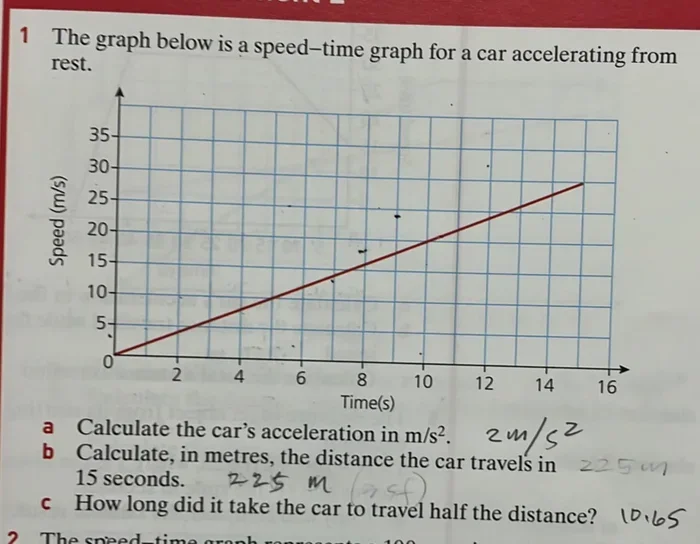
Acceleration is the rate at which the car’s velocity changes over time. When a car of mass m starts from rest, the initial velocity is zero. The acceleration depends directly on the net force and inversely on the mass of the car.
A lighter car accelerates faster than a heavier one if both produce the same engine force. This is why sports cars focus on keeping their weight low while maximizing power output. The math is simple: more force divided by less mass equals more acceleration.
The Acceleration Formula in Plain English
The formula is a = F divided by m. In everyday terms, this means:
- If you increase the engine force, acceleration goes up.
- If you increase the car’s mass, acceleration goes down.
- If both force and mass increase proportionally, acceleration stays the same.
This relationship explains why a small hatchback can outrun a large SUV from a stoplight, even if the SUV has a bigger engine. The weight difference often outweighs the extra horsepower.
Quick Tip: When comparing cars, always look at the power-to-weight ratio. This number tells you more about real-world acceleration than horsepower alone.
Friction, Traction, and Grip
Without friction, a car of mass m starts from rest would spin its wheels and go nowhere. Friction is the invisible force that makes motion possible. But not all friction helps — some of it works against the car.
Static Friction: The Launch Partner
Static friction is the force that keeps the tires gripping the road when the car is stationary. When you step on the gas, the engine tries to spin the wheels. Static friction between the tire rubber and the road surface prevents the wheels from slipping. This grip is what converts rotational force into forward motion.
On a wet or icy road, static friction drops dramatically. That is why tires spin uselessly on ice. The car of mass m starts from rest but cannot generate enough traction to move properly.
Rolling Resistance: The Hidden Enemy
Even on a dry road, rolling resistance works against the car. This force comes from the deformation of the tires as they roll along the surface. Softer tires create more rolling resistance, which means the engine has to work harder to maintain acceleration.
Experienced drivers and engineers pay close attention to tire pressure and tread design because these factors directly affect how efficiently a car moves from a standstill.
Drag Force: The Speed Limiter
Once the car picks up speed, aerodynamic drag becomes a major factor. Air resistance grows with the square of velocity. This means doubling your speed quadruples the drag force. At low speeds right after launch, drag is minimal. But as the car continues to accelerate, drag becomes the biggest opponent the engine has to fight.
Energy Transformation: From Fuel to Motion
When a car of mass m starts from rest, energy undergoes a remarkable transformation. Chemical energy stored in fuel converts into thermal energy through combustion. That thermal energy becomes mechanical energy in the engine. And finally, mechanical energy turns into kinetic energy as the car gains speed.
Each step in this chain loses some energy as heat. That is why internal combustion engines are typically only 25 to 35 percent efficient. The rest of the energy escapes through the exhaust, cooling system, and friction in moving parts.
Kinetic Energy and Its Importance
Kinetic energy is the energy of motion. It depends on both mass and the square of velocity. The formula is KE = one-half times m times v squared. This means that a car moving at 60 mph has four times the kinetic energy of the same car moving at 30 mph.
This relationship has huge implications for safety and braking distance. When a car of mass m starts from rest and gains speed, it accumulates kinetic energy. To stop, the brakes must convert all that kinetic energy back into heat through friction. The faster you go, the more energy the brakes must absorb, and the longer your stopping distance becomes.
Work Done by the Engine
Work is force applied over a distance. The engine does work on the car by applying force through the drivetrain as the car covers ground. The total work done equals the change in kinetic energy of the car. This is known as the work-energy theorem.
When a car starts from rest, all the work done by the engine goes into increasing the car’s kinetic energy. In a perfect world with no friction or drag, every bit of fuel energy would translate into motion. But in reality, losses at every stage mean you get less motion than you put in.
Momentum: The Quantity of Motion
Momentum is the product of mass and velocity. It describes how hard it is to stop a moving object. When a car of mass m starts from rest, its initial momentum is zero. As it accelerates, momentum builds steadily.
Momentum matters in collisions and safety scenarios. A heavier car or a faster car carries more momentum, which means it takes more force to stop it. This is why vehicle weight is such an important factor in crash safety and insurance ratings.
Conservation of Momentum
In any closed system, momentum is conserved. This principle explains why heavier cars tend to fare better in collisions with lighter objects. The heavier car has more momentum, and during a crash, that momentum must go somewhere — usually into deformation of the vehicles involved.
Real-World Factors That Change the Equation
The textbook physics of a car of mass m starting from rest is clean and simple. But real-world driving introduces many variables that change how the car behaves at launch.
Weight Distribution
Where the car’s mass is located matters a lot. A front-heavy car puts more weight on the front tires, which gives better traction at the driven wheels if the car is front-wheel drive. A rear-heavy car benefits rear-wheel drive launches. Engineers spend years optimizing weight distribution for the best possible acceleration and handling.
Road Surface and Conditions
Dry asphalt offers great grip. Wet roads reduce traction significantly. Gravel or snow nearly eliminates it. The same car of mass m starts from rest on different surfaces will behave completely differently depending on the available friction.
Tire Type and Condition
Performance tires with soft rubber compounds provide maximum grip. All-season tires are more versatile but sacrifice some traction. Worn tires with low tread depth lose grip in all conditions. Tire choice is one of the easiest and most affordable ways to improve launch performance.
Engine Power and Power Delivery
Horsepower and torque are the two numbers everyone looks at when evaluating a car’s acceleration ability. Torque is the twisting force the engine produces, and it is what gets the car moving from rest. Horsepower is torque multiplied by RPM, and it determines how fast the car can sustain acceleration at higher speeds.
A car with high torque at low RPMs will launch hard and feel responsive off the line. A car with high horsepower but low low-end torque may feel sluggish at startup but will have strong top-end speed.
Transmission and Gear Ratios
The transmission plays a crucial role in how a car accelerates from rest. Lower gears multiply engine torque, giving the wheels more force at the start. As the car picks up speed, higher gears reduce the torque multiplication but allow the engine to spin faster and produce more horsepower.
Manual transmissions give drivers control over gear selection. Automatic transmissions use complex hydraulic systems and electronic controls to shift at optimal points. Modern dual-clutch transmissions can shift gears in milliseconds, making launches incredibly fast and smooth.
Common Mistakes People Make About Car Acceleration
Even experienced drivers sometimes misunderstand how acceleration works. Here are a few common mistakes to avoid.
- Revving the Engine Too High at Launch: This wastes fuel and can cause wheel spin without adding much forward motion.
- Ignoring Tire Maintenance: Worn or improperly inflated tires kill traction and increase stopping distance.
- Overloading the Vehicle: Extra weight increases mass and reduces acceleration, fuel economy, and braking performance.
- Assuming Horsepower Equals Speed: Torque and power-to-weight ratio matter just as much as raw horsepower numbers.
- Neglecting Aerodynamic Modifications: At higher speeds, even small changes in body shape can significantly affect drag and top speed.
Expert Insights on Vehicle Launch Dynamics
Automotive engineers approach the question of how a car of mass m starts from rest with deep scientific rigor. They use computer simulations, wind tunnels, and track testing to optimize every variable.
Dr. Sarah Chen, a vehicle dynamics engineer, explains: “The launch is the most critical moment in any acceleration event. Everything the driver does in the first two seconds — throttle input, clutch engagement, gear selection — sets the tone for the entire run.”
Experts also emphasize that driver technique plays a huge role. A skilled driver can extract more performance from an average car than an average driver can from a high-performance machine. Smooth throttle application, proper clutch modulation, and anticipating road conditions all contribute to better launches.
Another expert insight comes from the world of electric vehicles. Electric motors deliver maximum torque from zero RPM, which means an EV of mass m starts from rest with instant, seamless acceleration. This is one reason electric cars feel so quick off the line compared to similar-sized combustion vehicles.
How Technology Has Changed the Launch Experience
Modern cars come packed with technology designed to optimize launches and acceleration. Traction control systems monitor wheel slip and adjust engine power to prevent spinning. Launch control systems hold the engine at the optimal RPM for maximum traction. Electronic stability control keeps the car on its intended path even during aggressive acceleration.
These technologies make launches safer and more consistent. They also help less experienced drivers get the most out of their vehicles without damaging tires or drivetrain components.
Putting It All Together: What Really Happens When You Start Driving
Let us walk through the entire sequence one more time. You sit in the driver’s seat of a car of mass m. The engine is off, and the car is at rest. Zero velocity. Zero momentum. Zero kinetic energy.
You turn the ignition. The engine fires up. You press the gas pedal. The engine produces torque. That torque reaches the wheels through the transmission. The tires push against the road. Static friction grips back. The net force accelerates the car forward.
Within seconds, the car has gained velocity and momentum. Kinetic energy builds rapidly. Rolling resistance and aerodynamic drag begin to oppose the motion. The car continues to accelerate as long as the engine force exceeds the opposing forces.
When you lift off the gas, the driving force drops. Friction and drag gradually slow the car down. The kinetic energy converts back into heat through the brakes if you apply them, or dissipates through air resistance if you coast.
Every single drive you take involves this exact sequence of physics in action. Understanding it makes you a more informed driver, a smarter car buyer, and a more safety-conscious road user.
The beauty of this concept is that it applies to every vehicle on the road — from a tiny city scooter to a massive freight truck. The principles of force, mass, acceleration, and energy never change. They are universal laws that shape how everything with mass moves through space.
Conclusion
A car of mass m starts from rest and transforms from a stationary object into a moving machine through the elegant interplay of force, friction, and energy. The physics behind this everyday event is both beautiful and practical. By understanding how acceleration works, what role mass plays, and why factors like traction and drag matter, you gain a deeper appreciation for the vehicles you drive and the roads you travel.
Knowledge about how a car of mass m starts from rest empowers you to make better decisions about vehicle maintenance, driving technique, and even car purchases. The next time you press the gas pedal at a stoplight, remember the incredible chain of events happening beneath you. Force becomes motion. Energy transforms from one form to another. And you, the driver, are at the center of it all.
Take this knowledge and apply it. Check your tire pressure regularly. Understand your car’s power-to-weight ratio. Respect the physics of momentum and braking distance. These small actions add up to safer, more efficient, and more enjoyable driving for everyone on the road.
Frequently Asked Questions
What does it mean when we say a car of mass m starts from rest?
It means the car is initially stationary with zero velocity, and an engine force causes it to accelerate and begin moving. This scenario is a classic example of Newton’s second law in action, where net force equals mass times acceleration.
How does mass affect a car’s acceleration from a standstill?
A heavier car requires more force to achieve the same acceleration as a lighter car. Since acceleration equals force divided by mass, increasing the mass while keeping force constant reduces the acceleration. This is why lightweight cars often feel quicker off the line.
What role does friction play when a car starts moving?
Friction is essential for a car to move forward. Static friction between the tires and the road surface provides the grip needed to convert engine torque into forward motion. Without sufficient friction, the wheels would simply spin in place.
Is horsepower or torque more important for a car starting from rest?
Torque is more important for launch acceleration because it is the rotational force that directly pushes the car forward from a standstill. Horsepower becomes more relevant at higher speeds where sustained acceleration matters. A balance of both delivers the best overall performance.
How does kinetic energy increase as the car gains speed?
Kinetic energy increases with the square of velocity. This means a car moving at twice the speed has four times the kinetic energy. This relationship is critical for understanding braking distances and crash forces at different speeds.
Can road conditions really change how a car of mass m starts from rest?
Absolutely. Wet, icy, or gravel roads reduce the friction between tires and the surface, which limits traction and makes launches less effective. Tire type, tread depth, and road surface all directly influence how well a car can convert engine force into forward motion.
=== CONCLUSION ===
The journey of a car of mass m starts from rest is a story of physics in motion. From the moment the engine fires to the point where the car reaches cruising speed, every concept we discussed — force, acceleration, friction, energy, momentum — plays a vital role. These principles are not just academic exercises. They are the real-world mechanics that shape every drive you take.
By understanding these fundamentals, you become a more knowledgeable and confident driver. You appreciate why maintenance matters, why driving technique counts, and why physics never takes a day off. Keep learning, keep driving safely, and enjoy the incredible science happening every time you hit the road.