Oxygen Sensor Car Price What to Expect When Replacing
Replacing an oxygen sensor typically costs between $100 and $300 for parts and labor, though prices vary by vehicle model and sensor type. Understanding the oxygen sensor car price helps you budget for this common car maintenance repair. This guide covers costs, symptoms, and tips to save money on your next O2 sensor replacement.
You are driving down the road, and your check engine light suddenly flickers on. One of the first things that pops into your head is probably the oxygen sensor car price. It is a common worry for car owners. The good news is that replacing an O2 sensor is one of the most affordable repairs you can do. In this guide, we will walk you through everything you need to know about oxygen sensor replacement costs, symptoms, and how to save money.
Your car has a very important job to do. It needs to burn fuel efficiently and keep emissions low. The oxygen sensor plays a huge role in both. When this small part starts to fail, your car performance drops. You might notice rough idling, poor fuel economy, or a glowing check engine light. Understanding what the oxygen sensor car price involves can help you make smart decisions before heading to the shop.
So what exactly will you pay? The answer depends on several factors. Your vehicle make and model matter a lot. The type of sensor you choose matters too. Whether you go with an OEM part or an aftermarket option changes the cost. And whether you do the work yourself or hire a mechanic is a big factor. Let us break all of this down in detail.
Key Takeaways
- Average Cost: Most drivers pay between $100 and $300 for a single oxygen sensor replacement.
- Sensor Type Matters: OEM sensors cost more than aftermarket options but may offer better longevity.
- Location Affects Price: Upstream sensors are usually more expensive and harder to access than downstream ones.
- DIY Saves Money: Replacing the sensor yourself can cut labor costs entirely.
- Ignoring Symptoms Raises Costs: A failing O2 sensor can lead to catalytic converter damage if left unchecked.
- Multiple Sensors Add Up: Vehicles with four sensors will cost more for full replacement.
- Regular Maintenance Helps: Proper car care can extend oxygen sensor lifespan and prevent early failure.
📑 Table of Contents
What Is an Oxygen Sensor and Why Does It Matter?
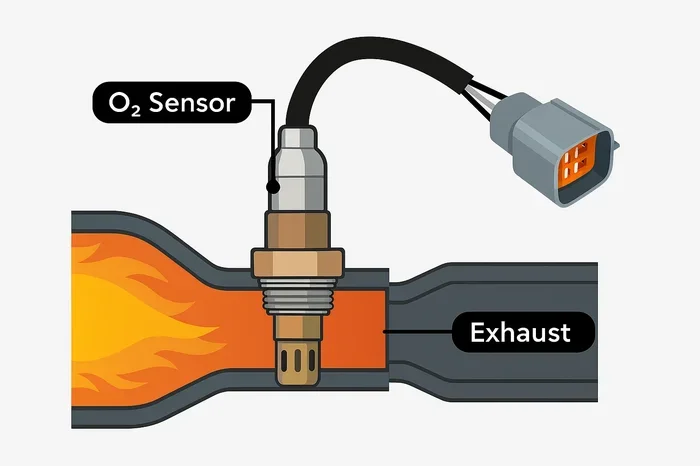
Before we dive into the oxygen sensor car price, let us understand what this part does. The oxygen sensor, also called the O2 sensor, sits in your exhaust system. Its job is to measure how much oxygen is in your car’s exhaust gases. This information goes straight to your car’s computer, known as the engine control unit or ECU.
The ECU uses this data to adjust the fuel-to-air mixture. If the mixture is too rich or too lean, your engine does not run well. A properly working oxygen sensor keeps everything balanced. It helps your engine run smoothly, improves fuel economy, and reduces harmful emissions.
Types of Oxygen Sensors
Not all oxygen sensors are the same. There are a few different types you might encounter.
- Upstream Oxygen Sensor: This sensor sits before the catalytic converter. It measures exhaust gases before they get cleaned. It plays a direct role in fuel trim adjustments.
- Downstream Oxygen Sensor: This one sits after the catalytic converter. It monitors how well the converter is doing its job. It usually has a slower response time.
- Wideband Oxygen Sensor: This newer type provides more precise readings. Many modern cars use wideband sensors for better fuel efficiency.
- Narrowband Oxygen Sensor: This is the older style found in many cars. It gives a simpler on-off reading rather than a precise measurement.
Knowing which type your car uses can affect the oxygen sensor car price you will pay. Wideband sensors tend to cost more than narrowband ones. And upstream sensors are often pricier than downstream sensors because of their location and function.
Oxygen Sensor Car Price: What to Expect
Now let us get to the part you really want to know about. What does it actually cost to replace an oxygen sensor? The oxygen sensor car price can range quite a bit. But most drivers spend somewhere in the middle of the range. Let us look at the numbers.
Average Cost Breakdown
Here is a general idea of what you might pay. Keep in mind these are national averages in the United States. Your actual cost may be higher or lower depending on where you live.
| Sensor Type | Parts Cost | Labor Cost | Total Average |
|---|---|---|---|
| Upstream O2 Sensor | $50 – $150 | $50 – $100 | $100 – $250 |
| Downstream O2 Sensor | $40 – $120 | $40 – $80 | $80 – $200 |
| Wideband O2 Sensor | $80 – $200 | $50 – $100 | $130 – $300 |
| Full Set (All Sensors) | $200 – $600 | $150 – $300 | $350 – $900 |
As you can see, the oxygen sensor car price for a single sensor usually falls between $100 and $300. If your car has multiple sensors and they all need replacing, the total bill will go up. But replacing them one at a time can help spread out the cost.
OEM vs Aftermarket Sensors
One of the biggest factors in the oxygen sensor car price is whether you choose an OEM part or an aftermarket option.
OEM sensors are made by the same manufacturer that built your car. They are designed to meet the exact specifications of your vehicle. OEM sensors tend to cost more, but they often fit better and last longer. If you have a newer or luxury vehicle, going with OEM is usually the safer choice.
Aftermarket sensors are made by third-party companies. They cost less than OEM parts. Many aftermarket sensors work just as well. But quality can vary between brands. Some cheaper aftermarket sensors may fail sooner or give less accurate readings.
Here is a quick comparison to help you decide.
| Feature | OEM Sensor | Aftermarket Sensor |
|---|---|---|
| Price Range | $60 – $180 | $30 – $120 |
| Fit and Finish | Exact match | Varies by brand |
| Warranty | Usually longer | Varies widely |
| Durability | Very reliable | Good to moderate |
| Best For | Newer and luxury cars | Budget-conscious repairs |
For most everyday cars, a quality aftermarket sensor is a smart way to save money on the oxygen sensor car price. Just make sure you buy from a reputable brand.
How Vehicle Type Affects the Price
The oxygen sensor car price is not one-size-fits-all. Your vehicle type plays a big role in what you will pay.
- Compact Cars: These usually have fewer sensors and simpler exhaust systems. Replacement costs tend to be on the lower end.
- Sedans and Mid-Size Cars: Standard four-cylinder and V6 engines typically have two to four sensors. Costs fall in the average range.
- Trucks and SUVs: Larger engines often have more sensors. V8 engines and diesel trucks can have four or more sensors. The oxygen sensor car price goes up accordingly.
- Luxury and Performance Vehicles: These cars often use premium sensors and have harder-to-access locations. Labor costs are higher. Expect to pay more for parts and service.
If you are unsure how many sensors your car has, check your owner’s manual or ask your mechanic. This gives you a clearer picture of the total oxygen sensor car price for your specific vehicle.
Common Symptoms of a Failing Oxygen Sensor
How do you know it is time to replace your oxygen sensor? There are several warning signs that should not be ignored. Catching these symptoms early can save you from bigger, more expensive repairs down the road.
Check Engine Light
The most common sign of a bad oxygen sensor is the check engine light. Your car’s computer detects an issue with the O2 sensor reading and triggers the light. While the check engine light can mean many things, a failing oxygen sensor is one of the top causes. A simple OBD2 scanner can confirm the problem.
Poor Fuel Economy
Have you noticed you are visiting the gas station more often? A failing oxygen sensor can send wrong data to your engine computer. This causes the engine to burn more fuel than it needs. If your fuel economy drops suddenly, a bad O2 sensor could be the culprit.
Rough Idle or Stalling
A bad oxygen sensor can make your engine run rough when idling. You might feel vibrations or hear unusual sounds from the engine bay. In some cases, the engine may stall at stop lights or in traffic. These are clear signs that something is off with your fuel mixture.
Failed Emissions Test
If your car fails an emissions test, a faulty oxygen sensor is a common reason. The sensor helps control the air-fuel mixture. When it fails, your car produces more pollutants. This is bad for the environment and can keep your car from passing inspection.
Reduced Engine Performance
A failing O2 sensor can cause sluggish acceleration and a lack of power. You might feel hesitation when pressing the gas pedal. Your engine may not respond the way it used to. This happens because the fuel mixture is not properly balanced.
Quick Tip
Do not ignore the check engine light. Even if your car seems to drive fine, a failing oxygen sensor can cause hidden damage over time. Get it checked as soon as possible.
Can You Replace an Oxygen Sensor Yourself?
Many car owners wonder if they can save money by replacing the oxygen sensor themselves. The answer is yes, in most cases. DIY replacement can significantly reduce the oxygen sensor car price by eliminating labor costs entirely.
What You Will Need
Replacing an oxygen sensor is not overly complicated. Here is what you typically need:
- A new oxygen sensor (OEM or aftermarket, depending on your choice)
- An oxygen sensor socket or wrench (usually 7/8 inch or 22mm)
- A ratchet and extension
- penetrating oil like WD-40 or PB Blaster
- A car jack and jack stands or ramps
- An OBD2 scanner to clear error codes after replacement
Step-by-Step Overview
Here is a quick look at the process.
- Locate the oxygen sensor. It will be on the exhaust manifold or exhaust pipe.
- Spray penetrating oil on the sensor if it is stuck. Let it sit for 10 to 15 minutes.
- Disconnect the electrical connector from the sensor.
- Use the oxygen sensor socket to unscrew the old sensor.
- Apply anti-seize compound to the threads of the new sensor (if not pre-applied).
- Screw in the new sensor by hand first, then tighten with the socket.
- Reconnect the electrical connector.
- Start the car and check for error codes with the OBD2 scanner.
For most vehicles, the entire process takes about 20 to 45 minutes per sensor. It is one of the easier car maintenance tasks you can do at home.
When to Call a Professional
DIY replacement is not always the best choice. If the sensor is deeply buried in the exhaust or rusted in place, it can be very difficult to remove. In these cases, a mechanic has the tools and experience to get the job done safely. Also, if you are not comfortable working under your car, it is perfectly fine to let a professional handle it.
The oxygen sensor car price for professional replacement includes both parts and labor. But you get the peace of mind that comes with a warranty and expert installation.
How to Save Money on Oxygen Sensor Replacement
Nobody wants to overspend on car repairs. Here are some practical tips to help you save money on the oxygen sensor car price.
Buy Parts Online
Ordering your oxygen sensor online is often much cheaper than buying it from a dealership or auto parts store. Many online retailers offer quality parts at lower prices. Just make sure you get the right part number for your specific vehicle.
Compare Labor Rates
Mechanic labor rates vary widely by location. A quick call to a few shops in your area can save you money. You can also check online reviews to find a trustworthy and fairly priced mechanic.
Replace Sensors in Pairs
If one oxygen sensor has failed, the other one on the same bank may be close to failing too. Replacing them together can save you money on repeat labor charges. Your mechanic only needs to do the job once instead of twice.
Do Not Delay the Repair
Ignoring a failing oxygen sensor can lead to bigger problems. A bad sensor can cause your catalytic converter to overwork and eventually fail. Replacing a catalytic converter costs $500 to $2,500 or more. That is a much bigger bill than an O2 sensor replacement. So do not put off this repair.
Expert Insight
Most mechanics agree that replacing an oxygen sensor as soon as it fails is the best approach. Waiting only increases the risk of damage to other expensive parts like the catalytic converter. Catching the problem early keeps your oxygen sensor car price low and your car running smoothly.
How Long Does an Oxygen Sensor Last?
Oxygen sensors do not last forever. Over time, they wear out from exposure to heat, exhaust gases, and contaminants. Understanding the oxygen sensor lifespan helps you plan for replacement before it becomes an emergency.
Most oxygen sensors last between 50,000 and 100,000 miles. Some higher-quality sensors can last even longer. However, several factors can shorten their lifespan:
- Contaminated fuel or oil additives
- Coolant leaks into the exhaust system
- Excessive carbon buildup
- Driving in stop-and-go traffic frequently
- Exposure to road salt and harsh conditions
Regular car maintenance can help extend the life of your oxygen sensors. Using quality fuel, fixing coolant leaks quickly, and keeping up with oil changes all contribute to a healthier exhaust system.
Oxygen Sensor Replacement Interval
There is no set replacement interval for oxygen sensors. Unlike oil changes or tire rotations, O2 sensors are replaced only when they fail. However, some mechanics recommend checking them during routine service after 60,000 miles. This proactive approach can catch problems early and keep the oxygen sensor car price manageable.
Common Mistakes to Avoid
When dealing with oxygen sensor replacement, there are a few common mistakes that car owners should avoid.
Replacing the Wrong Sensor
Not all check engine lights related to oxygen sensors point to the same sensor. Your car may have multiple O2 sensors, and each one has a specific location and function. Always confirm which sensor is causing the problem before buying a replacement.
Using Cheap Aftermarket Parts Without Research
Saving a few dollars on a cheap sensor can backfire. Low-quality aftermarket sensors may not fit properly or give inaccurate readings. This can cause ongoing performance issues and trigger the check engine light again. Spend a few extra dollars on a reputable brand.
Skipping the Anti-Seize Compound
If you are doing a DIY replacement, do not forget the anti-seize compound on the threads. Without it, the new sensor can seize in place over time. Then you face a much harder and more expensive removal job later.
Ignoring Related Problems
Sometimes a failing oxygen sensor is a symptom of a bigger issue. Oil burning, coolant leaks, or exhaust leaks can all damage O2 sensors. Simply replacing the sensor without fixing the root cause will lead to the same problem again.
Conclusion
The oxygen sensor car price is something most drivers will face at some point. Whether you have a compact car or a full-size truck, understanding the costs involved helps you make informed decisions. On average, you can expect to pay between $100 and $300 for a single sensor replacement, though the final bill depends on your vehicle, the sensor type, and whether you choose OEM or aftermarket parts.
Do not let the oxygen sensor car price scare you into delaying the repair. A failing oxygen sensor affects your fuel economy, engine performance, and emissions. Catching the problem early saves you money and keeps your car running at its best. Whether you choose to do the job yourself or visit a trusted mechanic, this is a repair worth taking care of promptly.
Keep an eye out for the warning signs we discussed. Address the check engine light quickly. Stay on top of your car maintenance routine. And remember, a small investment in replacing your oxygen sensor today can prevent much bigger expenses tomorrow.
Frequently Asked Questions
How much does it cost to replace an oxygen sensor?
The oxygen sensor car price typically ranges from $100 to $300 for a single sensor, including parts and labor. The exact cost depends on your vehicle model, the type of sensor, and whether you choose OEM or aftermarket parts. DIY replacement can lower the cost by removing the labor charge entirely.
Can I drive with a bad oxygen sensor?
You can drive short distances with a failing oxygen sensor, but it is not recommended. A bad O2 sensor can cause poor fuel economy, rough idling, and increased emissions. Over time, it can also damage your catalytic converter, which is a much more expensive repair. Have the sensor replaced as soon as possible.
How do I know which oxygen sensor needs replacing?
The best way to identify the failing sensor is by using an OBD2 scanner. The scanner will read the specific error code stored in your car’s computer. Each oxygen sensor has its own code, so the scanner tells you exactly which one to replace. Your mechanic can also perform a diagnostic test to pinpoint the problem.
Does the oxygen sensor car price include taxes and fees?
Most quotes for oxygen sensor replacement include parts, labor, and applicable taxes. However, some shops may quote the parts and labor separately. Always ask for a detailed breakdown before approving the repair. This helps you avoid surprise charges and ensures you are getting a fair price.
How long does the oxygen sensor replacement take?
A professional mechanic can usually replace a single oxygen sensor in 30 to 60 minutes. DIY replacement takes a similar amount of time for most vehicles. If the sensor is rusted or hard to access, the job may take longer. Planning for about an hour per sensor is a safe estimate.
Will a new oxygen sensor improve my gas mileage?
Yes, in most cases. A failing oxygen sensor sends incorrect data to your engine computer, which can cause your car to run too rich or too lean. Replacing the sensor restores the correct fuel-to-air ratio. This often leads to noticeable improvements in fuel economy, sometimes by a few miles per gallon.
=== SEO Title ===
Oxygen Sensor Car Price: What to Expect When Replacing
=== META TITLE ===
Oxygen Sensor Car Price Guide: Replacement Costs Explained
=== URL SLUG ===
oxygen-sensor-car-price-what-to-expect-when-replacing