Where Can I Charge My Electric Car at Home or on the Road
Where Can I Charge My Electric Car? You can charge at home using a wall-mounted charger or a standard outlet, and on the road at public EV charging stations, shopping centers, and highway rest stops. This guide covers every option, from Level 1 and Level 2 home setups to DC fast charging networks, so you always know how to keep your battery full.
If you own an electric vehicle or are thinking about buying one, one question probably keeps popping up: where can I charge my electric car? The good news is that charging options have exploded in the last few years. You are no longer limited to a single charging spot or a complicated setup. Today, you can charge at home, at work, at the grocery store, and even on long road trips.
Whether you live in a house with a garage or an apartment with shared parking, there is a solution for you. This guide walks you through every charging option available today. We will cover home setups, public stations, fast charging, and practical tips that make EV ownership simple and stress-free.
Key Takeaways
- Home Charging Is the Easiest Option: A Level 2 wall-mounted charger lets you plug in overnight and wake up to a full battery every morning.
- Public Charging Stations Are Everywhere: Grocery stores, malls, parks, and highway rest stops now offer convenient charging while you run errands or take a break.
- DC Fast Charging Gets You Back on the Road Fast: These stations can add 100+ miles of range in just 20 to 30 minutes.
- Charging Cost Varies by Location: Home charging is usually cheapest, while public stations may charge per minute or per kilowatt-hour.
- Knowing Your Options Reduces Range Anxiety: With multiple charging methods available, you can confidently drive anywhere without worrying about running out of power.
📑 Table of Contents
- Charging at Home: The Most Convenient Option
- Charging on the Road: Public Charging Stations
- Charging at Work and Apartment Buildings
- Charging Costs: What You Actually Pay
- Charging Adapters and Connectors: What You Need to Know
- Dealing with Range Anxiety and Charging Confidence
- Future of EV Charging: What’s Coming Next
- Conclusion
Charging at Home: The Most Convenient Option
Charging at home is the easiest and most affordable way to keep your car powered. You plug in when you arrive home and unplug when you leave in the morning. It is just like charging your phone overnight.
Level 1 Charging: The Basic Setup
Every electric car comes with a Level 1 charging cable. This cable plugs into a standard 120-volt household outlet. You do not need any special equipment or installation. Just connect it and let it charge.
However, Level 1 charging is slow. It adds about 3 to 5 miles of range per hour. That means a fully depleted battery might take more than a day to charge completely.
- Best for: Plug-in hybrid owners or people who drive short daily distances.
- Cost: Free if you already have a standard outlet.
- Setup time: Zero. Just plug it in.
Level 2 Charging: The Home Upgrade That Changes Everything
A Level 2 charger uses a 240-volt outlet, similar to what a clothes dryer uses. This setup adds about 25 to 30 miles of range per hour. A full charge that would take all day on Level 1 can be done overnight with a Level 2 charger.
You will need an electrician to install a dedicated 240-volt circuit in your garage or carport. The cost for the charger and installation typically runs between $500 and $1,500. Many states and utility companies offer rebates that can cut this cost significantly.
Quick Tip: Look for the ENERGY STAR-certified EVSE (Electric Vehicle Supply Equipment) label. These chargers are efficient and safe.
Should You Install a Wall-Mounted Charger?
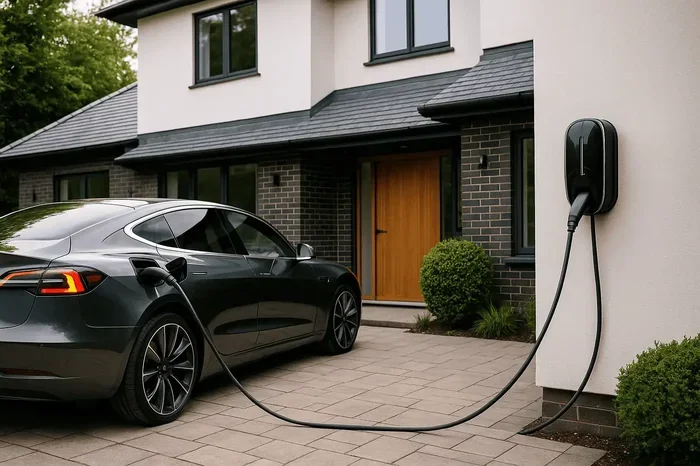
A wall-mounted charger, also called an EVSE, is the most popular home setup. It mounts on your garage wall and connects directly to your car with a charging cable. Popular brands include ChargePoint, JuiceBox, and Wallbox.
- Pros: Fast charging, smart features, scheduled charging, and compact design.
- Cons: Requires professional installation and upfront cost.
Most EV owners say that once they install a Level 2 charger at home, they never think about charging again. You just plug in every night and start each day with a full tank, so to speak.
Charging on the Road: Public Charging Stations
Even if you charge at home, you will need public charging options for road trips, errands, and days when you forget to plug in overnight. The good news is that public charging infrastructure has grown dramatically.
Where to Find Public Charging Stations
Public charging stations are now located in many everyday places. You can find them at:
- Grocery stores and supermarkets
- Shopping malls and retail centers
- Parking garages and downtown lots
- Restaurants and coffee shops
- Hotels and resorts
- Highway rest stops and travel centers
- Workplace parking lots
Apps like PlugShare, ChargePoint, and EVgo help you locate nearby stations in real time. These apps show you the station type, availability, and even user reviews. Before you head out on a trip, just check the map and plan your stops.
Level 2 Public Chargers
Most public charging stations use Level 2 equipment. These are the same type of charger you would install at home. They work well for topping off your battery while you shop, eat, or run errands.
A Level 2 public charger typically adds 10 to 20 miles of range per hour. So if you park for two hours at the grocery store, you come back with 20 to 40 extra miles of range.
Common Mistake: Do not assume all public stations are free. Some charge a flat fee, while others bill by the minute or per kilowatt-hour. Always check the pricing before you plug in.
DC Fast Charging: The Road Trip Game-Changer
DC fast chargers, often called Level 3 chargers, are the quickest option available. They use high-powered equipment to deliver energy directly to your battery at much faster rates.
With DC fast charging, you can add 100 to 200 miles of range in just 20 to 30 minutes. This makes long road trips much more practical and reduces the need for long stops.
Popular DC fast charging networks include:
- Tesla Supercharger: Exclusive to Tesla vehicles, but Tesla is opening some stations to other brands.
- Electrify America: Available to all EV brands, with widespread coverage across the U.S.
- EVgo: Found in urban areas and along major highways.
- ChargePoint DC Fast: Expanding rapidly across the country.
Expert Insight: DC fast charging works best for topping off on trips. Using it every day can slightly reduce your battery’s long-term health. Reserve it for when you need a quick boost.
How Fast Charging Actually Works
DC fast chargers bypass your car’s onboard charger and deliver power directly to the battery. This is why they are so much faster than Level 1 or Level 2 chargers. However, the actual speed depends on several factors:
- Your car’s battery size and model
- The maximum charging rate your car supports
- Battery temperature and current charge level
- The charger’s maximum power output
Most EV owners learn their car’s charging curve over time. For example, many cars charge fastest between 10% and 50%, then slow down as they approach 80%. This is why many drivers stop at 80% on road trips rather than waiting for a full charge.
Charging at Work and Apartment Buildings
Not everyone has a garage or dedicated parking with an outlet. But that does not mean you cannot charge conveniently. Let us look at two common situations.
Workplace Charging
More employers are installing EV charging stations in their parking lots. Workplace charging is a win-win. You arrive in the morning with a full battery and leave with even more charge than you started with.
Some companies offer free workplace charging as an employee benefit. Others charge a small fee that is still cheaper than gasoline. Check with your HR department or facilities manager to see if your workplace has a charging program or is planning one.
Apartment and Condo Charging
Living in an apartment or condo does not mean you are out of luck. Many property managers are now installing shared charging stations in their parking areas. Here are some steps you can take:
- Talk to your property manager or HOA. Explain the benefits of EV charging for tenants and property value.
- Check for existing infrastructure. Some newer buildings already have EV-ready wiring in the parking stalls.
- Look into shared charging apps. Apps like ChargePoint and EV Connect allow residents to book and pay for shared charging sessions.
- Consider portable chargers. If your parking spot has a standard 120-volt outlet, a Level 1 cable can still add some charge overnight.
Key Takeaway: Apartment charging is improving fast. The number of multi-family dwelling charging stations has grown by over 40% in the last two years, according to industry reports.
Charging Costs: What You Actually Pay
One of the biggest advantages of owning an electric car is lower fuel costs. But charging costs vary depending on where and how you charge.
Home Charging Costs
Home charging uses your regular electricity rate. The average U.S. electricity rate is about $0.16 per kilowatt-hour. Charging a 60-kWh battery from empty to full costs roughly $10 at home. Compare that to filling a gas tank, which often costs $50 or more.
Many utility companies offer special EV rates, especially for overnight charging. These time-of-use plans can cut your charging cost in half. It is worth calling your electric provider to ask about EV-friendly rate plans.
Public Charging Costs
Public charging costs vary widely:
- Free charging: Some malls, stores, and hotels offer free Level 2 charging to attract customers.
- Flat fee: Some networks charge a session fee of $1 to $3, regardless of how much energy you use.
- Per-kilowatt-hour pricing: Similar to home rates, usually $0.30 to $0.60 per kWh.
- Per-minute pricing: Common at DC fast chargers, typically $0.25 to $0.50 per minute.
Expert Insight: Download the apps for your preferred charging networks before you need them. Most apps let you save a payment method and start sessions without fumbling for a credit card at the station.
Comparison: Home vs. Public Charging Costs
| Charging Type | Average Cost per kWh | Typical Full Charge Cost (60 kWh) | Best For |
|---|---|---|---|
| Home (Level 2) | $0.13 – $0.20 | $8 – $12 | Daily overnight charging |
| Public Level 2 | $0.25 – $0.45 | $15 – $27 | Errands and topping off |
| DC Fast Charging | $0.40 – $0.69 | $24 – $41 | Road trips and quick boosts |
As you can see, home charging is significantly cheaper than public charging. But even public fast charging is usually less expensive than gasoline on a per-mile basis.
Charging Adapters and Connectors: What You Need to Know
Not all charging stations use the same plug. Understanding connectors helps you avoid frustration at the station.
Common Charging Connector Types
The two main connector types for Level 1 and Level 2 charging are J1772 and Tesla’s proprietary connector. Most non-Tesla EVs use the J1772 plug, while Tesla vehicles come with an adapter to use J1772 stations.
For DC fast charging, the main standards are:
- CCS (Combined Charging System): Used by most non-Tesla EV brands including Ford, GM, BMW, and Hyundai.
- CHAdeMO: Used primarily by Nissan Leaf and some older Mitsubishi models.
- Tesla Supercharger (NACS): Tesla’s own connector, now being adopted by other brands.
Quick Tip: If you drive a non-Tesla EV and want to use Tesla Superchargers, an adapter is available for purchase. Tesla is also opening its Supercharger network to all EV brands, making this a growing option.
Do You Need a Charging Adapter?
Most EV owners do not need multiple adapters. Your car comes with the necessary cable for home charging. For public stations, the main thing to know is whether the station matches your car’s port.
Charging networks like PlugShare and A Better Route Planner show which connector types are available at each station. This makes it easy to find compatible stations before you arrive.
Dealing with Range Anxiety and Charging Confidence
Range anxiety, or the fear of running out of charge before reaching a station, is real for many new EV owners. But with the charging infrastructure available today, it is manageable and often overblown.
Most modern electric cars offer 250 to 350 miles of range on a full charge. For daily driving, that is more than enough. The average American drives about 37 miles per day, which means most people only need to charge once or twice a week.
Tips for Building Charging Confidence
- Charge at home every night. This is the single best way to eliminate range anxiety. You always start your day with a full battery.
- Plan road trips with charging stops. Use apps like A Better Route Planner to map out charging stations along your route.
- Keep your battery between 20% and 80%. This range is ideal for daily use and battery health.
- Learn your car’s real-world range. Your car’s estimated range varies with speed, temperature, and terrain. After a few weeks, you will know what to expect.
- Have backup options. Know the charging stations near your regular routes. If one station is busy, you can find an alternative.
Expert Insight: Most experienced EV owners say that range anxiety fades after the first month of ownership. Once charging becomes part of your daily routine, it feels just as normal as stopping for gas.
Future of EV Charging: What’s Coming Next
The EV charging landscape is evolving fast. Several exciting developments are on the horizon that will make charging even easier and more accessible.
Ultra-Fast Charging
Companies are working on chargers that can deliver 350 kW or more of power. These ultra-fast chargers could add 200 miles of range in under 15 minutes. Several automakers and charging networks are already testing these systems at select locations.
Wireless Charging
Imagine parking your car over a charging pad and never needing to plug in. Wireless inductive charging is already available for some EV models and is expected to become more common in the coming years. Some automakers are even testing wireless charging roads that charge your car while you drive.
More Charging Stations Everywhere
The U.S. federal government has committed billions of dollars to expand the public charging network. Plans include installing fast chargers every 50 miles along major highways. This expansion will make long-distance EV travel even more convenient and accessible.
Key Takeaway: The charging infrastructure will only get better. If you are on the fence about switching to electric, now is a great time to make the move.
Conclusion
So, where can I charge my electric car? The answer is almost everywhere. You can charge at home with a simple wall-mounted charger, at work, at the grocery store, and at thousands of public stations across the country. DC fast chargers make road trips easy, and the charging network continues to grow every year.
Home charging remains the most convenient and cost-effective option for daily use. Plug in overnight, wake up to a full battery, and start your day without a second thought about range or charging. For longer trips, public stations and fast chargers fill in the gaps seamlessly.
The world of EV charging is no longer confusing or limited. With the right knowledge and a few simple tools, you can charge your electric car confidently wherever life takes you. Start by setting up home charging, download a charging app, and enjoy the freedom that comes with electric vehicle ownership.
Frequently Asked Questions
Can I charge my electric car using a regular household outlet?
Yes, you can. Every electric car comes with a Level 1 charging cable that plugs into a standard 120-volt outlet. However, this is the slowest option and adds only about 3 to 5 miles of range per hour. It works best for plug-in hybrids or short daily drives.
How long does it take to charge an electric car at a public station?
It depends on the station type. A Level 2 public charger typically takes 4 to 8 hours for a full charge. DC fast chargers can add 100 to 200 miles of range in 20 to 30 minutes, making them ideal for quick stops during road trips.
Is home charging cheaper than public charging?
Yes, home charging is almost always cheaper. Residential electricity rates average around $0.16 per kWh, while public stations often charge $0.30 to $0.69 per kWh. Charging at home can save you significant money over time.
Do I need to install a special outlet for a home charger?
For a Level 1 charger, no special outlet is needed. For a Level 2 charger, you need a dedicated 240-volt circuit installed by a licensed electrician. The installation cost typically ranges from $500 to $1,500, but many states offer rebates to help offset the expense.
Can I charge my electric car in the rain?
Yes, you can safely charge your electric car in the rain. All EV charging equipment is designed and tested to be weather-resistant. The charging port and cable connectors have built-in safety features that prevent electrical hazards in wet conditions.
What is the best app for finding EV charging stations near me?
PlugShare is one of the most popular and comprehensive apps for finding EV charging stations. Other great options include ChargePoint, EVgo, and A Better Route Planner. Most of these apps are free and let you filter by station type, connector, and availability.